One of the most common questions I receive is:
“How can I learn more Finnish vocabulary?”
Many learners immediately start searching for word lists, flashcards, or vocabulary books. While those tools can be useful, they often create a frustrating problem: you memorize hundreds of words but struggle to remember them when you actually need them.
The reason is simple.
Our brains remember language better when it is connected to meaning, emotions, stories, and real situations.
Stop Collecting Words
Many learners treat vocabulary like a collection.
They save long lists of words, write them in notebooks, and spend hours reviewing them. A few days later, most of those words are forgotten because they were never connected to anything meaningful.
Instead of asking:
“How many words did I learn today?”
Ask:
“Where did I find this word?”
The context is often more important than the word itself.
Learn Words Through Real Content
The easiest way to build vocabulary naturally is through content that genuinely interests you.
Read articles about topics you enjoy.
Listen to podcasts related to your hobbies.
Watch Finnish videos that you would watch even in your native language.
When you’re interested in the content, your attention shifts away from studying and toward understanding the message. That’s when vocabulary starts sticking naturally.
Learn Phrases, Not Single Words
Words rarely live alone.
They usually appear together with other words in predictable patterns.
For example, instead of learning:
- päätös = decision
Learn:
- tehdä päätös = make a decision
- tärkeä päätös = important decision
When you learn phrases, you’re learning vocabulary and sentence structure at the same time.
This makes speaking and writing much easier later.
Keep a Vocabulary Notebook Differently
Many vocabulary notebooks become giant dictionaries that are never opened again.
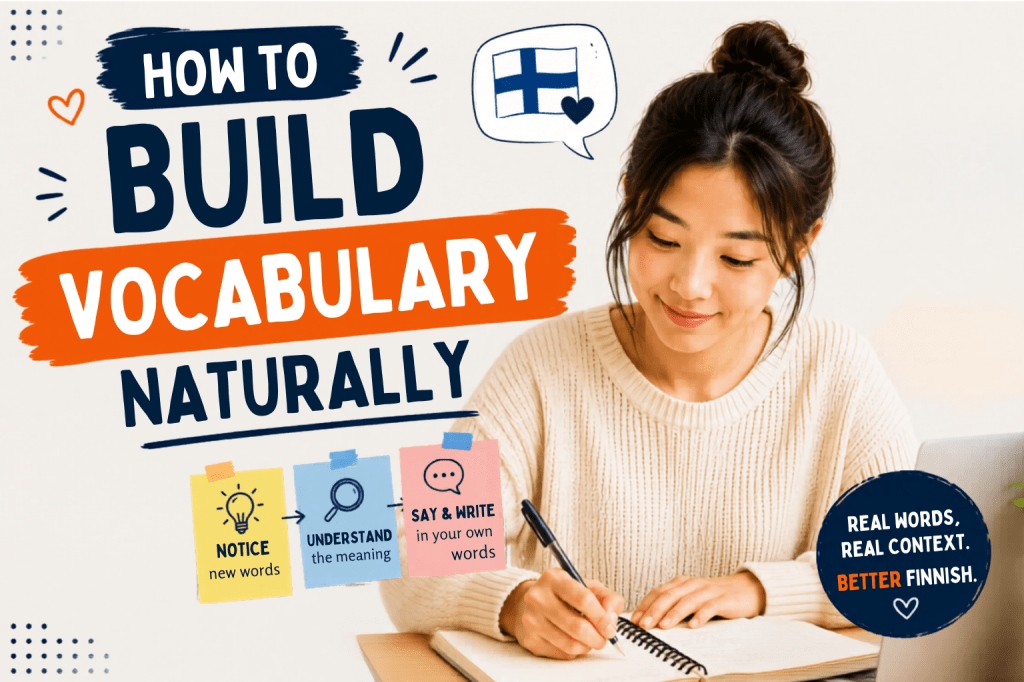
Instead of writing only the word and translation, try creating four columns:
New Word
Example Sentence
Meaning
My Own Sentence
Writing your own sentence forces your brain to actively use the word instead of simply recognizing it.
Even one sentence is often enough to make the word much more memorable.
Revisit Words Through Repetition
Vocabulary growth is not about seeing a word once.
It’s about meeting the same word again and again.
The first time you see a word, you notice it.
The second time, you recognize it.
The third or fourth time, you begin to understand how it is used.
Eventually, it becomes part of your active vocabulary.
This is why reading, listening, and consuming content regularly is so powerful.
Use Reverse Analysis
One of my favorite methods is what I call Reverse Analysis.
Find a short Finnish caption, article, podcast transcript, or social media post.
Instead of translating everything immediately, start by identifying familiar words, grammar patterns, sentence structures, and useful phrases. Then gradually work through the parts you don’t understand.
By analyzing real Finnish instead of isolated exercises, you’re learning vocabulary in the environment where native speakers actually use it.
Accept That Forgetting Is Normal
Many learners think forgetting means they learned something incorrectly. It doesn’t. Forgetting is a natural part of language learning.
Sometimes you’ll encounter the same word ten times before it finally stays in your memory. That’s completely normal. The goal isn’t to remember everything immediately.
The goal is to keep meeting the language often enough that important words eventually become familiar.
Final Thoughts
The fastest way to build vocabulary is often not to focus on vocabulary itself.
Focus on reading interesting content.
Focus on understanding messages.
Focus on collecting useful phrases and real examples.
Vocabulary is not something you memorize.
Vocabulary is something you gradually acquire by spending time with the language.

 Learn Finnish by My Way
Jätä kommentti