
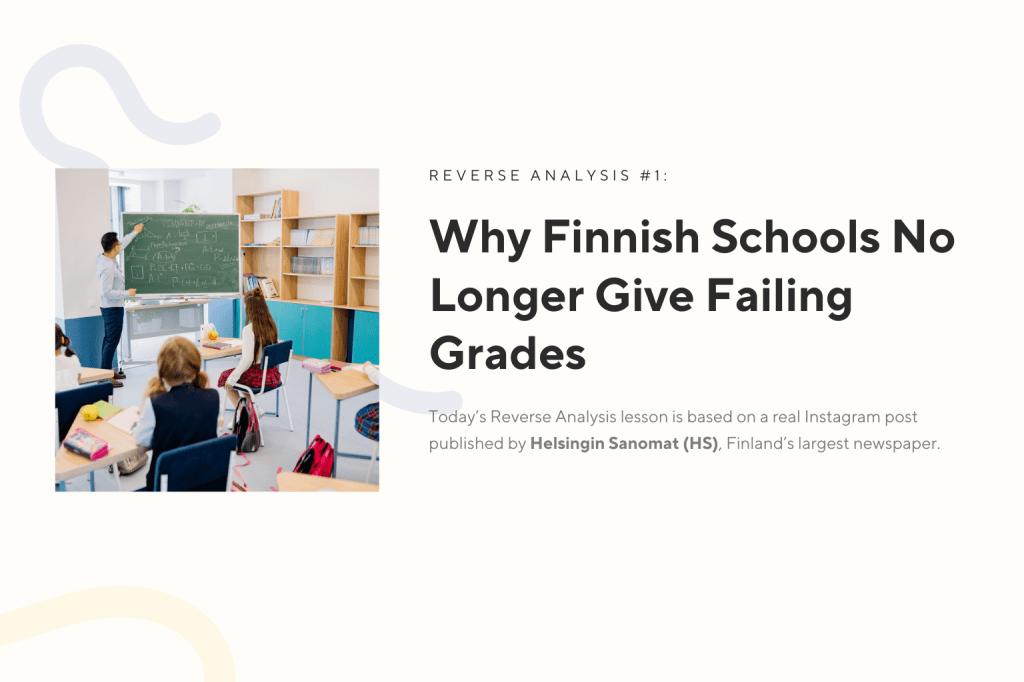
Today’s Reverse Analysis lesson is based on a real Instagram post published by Helsingin Sanomat (HS), Finland’s largest newspaper.
The post discusses a change in the Finnish school system and asks an interesting question:
“Why don’t Finnish schools give failing grades as often as before?”
Instead of simply translating the text, we’re going to use it as learning material.
In this lesson, we’ll break the article down sentence by sentence, identify useful vocabulary, recognize grammar patterns, and learn how Finnish is actually used in real-life media.
This is what I call Reverse Analysis — a learning method where one short piece of authentic Finnish content becomes a complete lesson in reading, vocabulary, grammar, listening, and writing.
If you’d like to learn the full Reverse Analysis process step by step, you can read my guide here:
→ How to Learn Finnish Through Reverse Analysis
Source: IG @helsinginsanomat

Example 1
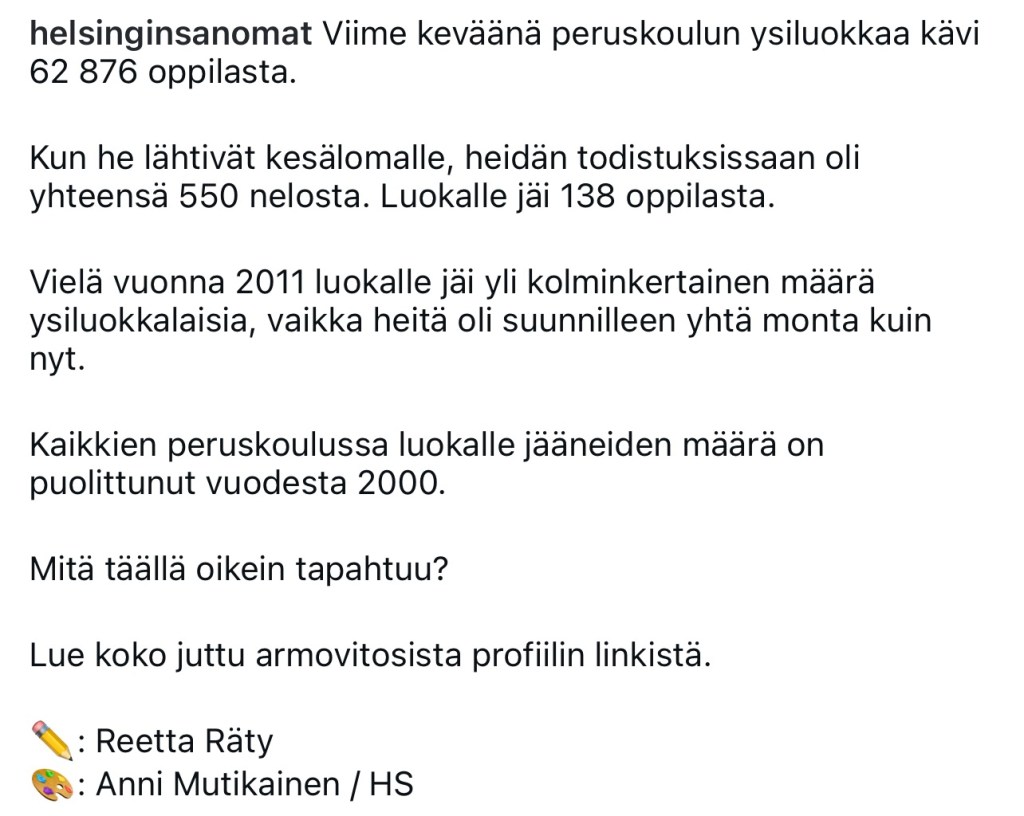
Viime keväänä peruskoulun ysiluokkaa kävi 62 876 oppilasta.
Viime keväänä = adverbial of time (last spring) → tells us the action happened in the past.
Kävi (irregular past tense of käydä) in this context means “attended school”.
Käydä + mitä? = to go through, attend, or take part in something.
Käydä koulua = to attend school (referring to the general process of studying at school). In this article, it refers to attending the 9th grade (ysiluokka).
62 876 oppilasta = after numbers, Finnish usually uses the partitive singular. If you’d like to learn more about this grammar point, read PARTITIVE AFTER NUMBERS.
Example 2
Kun he lähtivät kesälomalle, heidän todistuksissaan oli yhteensä 550 nelosta. Luokalle jäi 138 oppilasta.
Lähtivät = past tense of lähteä (to leave).
Lähteä kesälomalle = to leave for summer vacation (in this context, students finishing the school year and starting their summer break).
Heidän todistuksissaan contains a possessive structure (their report cards). If you’d like to learn more about Finnish possessive suffixes and how they are used, read POSSESSIVE SUFFIXES.
Jäi = past tense of jäädä (to remain, to stay behind).
Jäädä luokalle = to repeat a grade (be held back).
Vielä vuonna 2011 luokalle jäi yli kolminkertainen määrä ysiluokkalaisia, vaikka heitä oli suunnilleen yhtä monta kuin nyt.
Yli kolminkertainen määrä ysiluokkalaisia = more than three times as many ninth-grade students.
(How to express quantities and comparisons in Finnish.)
Example 3
Kaikkien peruskoulussa luokalle jääneiden määrä on puolittunut vuodesta 2000.
Kaikkien peruskoulussa luokalle jääneiden määrä = the number of all students who repeated a grade in comprehensive school.
On puolittunut = has been reduced by half / has halved.
This is an example of the PRESENT PERFECT TENSE in Finnish.
Example 4
Mitä täällä oikein tapahtuu?
Tapahtuu = happens / is happening.
This is a useful question expression that Finns often use when they are confused, surprised, or trying to understand a situation.
Example 5
Lue koko juttu arvovitosista profiilin linkistä.
Lue = imperative form (read!).
This is an example of the IMPERATIVE MOOD in Finnish.
Koko juttu = the full story / the entire article.
Profiilin linkistä = from the link in the profile.

 Learn Finnish by My Way
Jätä kommentti