
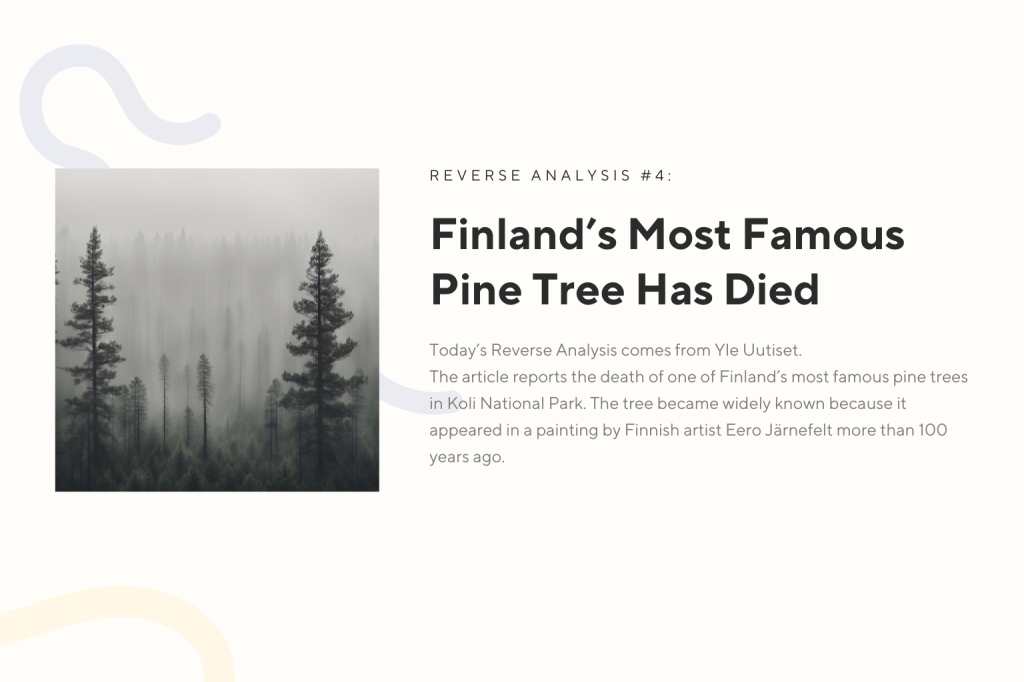
Today’s Reverse Analysis comes from Yle Uutiset.
The article reports the death of one of Finland’s most famous pine trees in Koli National Park. The tree became widely known because it appeared in a painting by Finnish artist Eero Järnefelt more than 100 years ago.
Besides learning new vocabulary about nature, this article contains several useful grammar structures often found in Finnish news articles.
Reading
Suomen kuuluisin mänty Kolilla on kuollut
Suomen tunnetuin mänty Kolin kansallispuistossa on kuollut.
Katso, miltä mänty näytti ikuistettuna Eero Järnefeltin maalaukseen yli sata vuotta sitten.
Mäkrävaaran laella seisova mänty on muuttunut Järnefeltin maalauksen ajoista, kun se on menettänyt latvansa.
Tuhannet retkeilijät ovat ikuistaneet puun patikoidessaan kansallispuistossa. Männyn kuoleman huomasi Ylen toimittaja retkeillessään Mäkrävaaralla.
Käkkyrämänty on pudottanut neulasensa ja seisoo nyt kuivuneena kelona.
Luontopalvelujen tiimivastaava Suvi Haapalehto kertoo, että Metsähallituksen työntekijät eivät olleet huomanneet männyn kuolemaa.
“Toisaalta tämä kuuluu normaaliin männyn elämään ja metsän sukkessioon.”
Reverse Analysis
| Finnish | Grammar & Analysis |
|---|---|
| Suomen tunnetuin mänty | Finland’s best-known pine tree. Genitive + superlative. |
| kansallispuistossa | In the national park. Inessive (-ssa). |
| on kuollut | Has died. Present perfect tense. olla + nut/nyt/lut/lyt |
| miltä mänty näytti | What the pine looked like. miltä + näyttää = what … looked like. |
| yli sata vuotta sitten | More than 100 years ago. |
| laella seisova mänty | A pine tree standing on the top. VA- partisiippi answers the question ”millainen?” millainen mänty? – laella seisova mänty |
| on muuttunut | Has changed. Present perfect. olla + nut/nyt |
| maalauksen ajoista | Since the time of the painting. Genetiivi + ajoista = since … |
| kun se on menettänyt latvansa | Since/when it lost its top. |
| latvansa | Its top. Possessive suffix -nsa. |
| Tuhannet retkeilijät | Thousands of hikers. |
| ovat ikuistaneet | Have immortalized / photographed. Present perfect. |
| patikoidessaan | While hiking. Kun – lauseenvastike patikoidessaan = kun he patikoi |
| huomasi | Noticed. Past tense of huomata (4) |
| retkeillessään | While hiking. Kun – lauseenvastike = Kun he retkeilevät |
| on pudottanut neulasensa | Has dropped its needles. |
| neulasensa | Its needles. Possessive suffix. |
| kuivuneena kelona | As a dried dead tree. Essive case (-na). |
| kertoo, että… | Says that… Common reporting structure. |
| eivät olleet huomanneet | Had not noticed. Negative past perfect tense. |
| kuuluu normaaliin männyn elämään | Is a normal part of a pine tree’s life. kuuluu + mihin (illatiivi) |
| metsän sukkessioon | Into the forest succession cycle. |
Grammar Notes
1. Present Perfect in News Finnish
News articles often use:
on + past participle
Examples:
- on kuollut = has died
- on muuttunut = has changed
- on menettänyt = has lost
- on pudottanut = has dropped
This tense describes something that happened in the past but is still relevant now.
2. Possessive Suffixes
The article contains two common examples:
latvansa
- latva = treetop
- latvansa = its treetop
neulasensa
- neulanen = needle
- neulasensa = its needles
Finnish often attaches ownership directly to the noun.
3. Kun – Lauseenvastike
KUN clause equivalent is a grammatical structure in Finnish that replaces a clause introduced by kun (when).
This -essa/-essä clause equivalent is mainly used in written Finnish and expresses that one action happens at the same time as the main action (present or future).
patikoidessaan = while hiking
retkeillessään = while hiking / trekking
Pattern:
verb stem + essa/essä + possessive suffix
You can see,
The construction is formed by adding the ending -essa/-essä to the verb stem.
Examples:
- lukiessaan = while reading
- syödessään = while eating
- kävellessään = while walking
This structure appears frequently in written Finnish and news articles.
4. VA- Participle
laella seisova mänty
= the pine tree standing on the summit
Here, seisova comes from the verb seisoa (to stand).
A VA participle describes the person or thing performing the action and works like an adjective.
- seisoa → seisova = standing
- laella seisova mänty = the pine tree that is standing on the summit
You will often see VA participles in news articles and written Finnish because they help shorten relative clauses.
Compare:
- Mänty, joka seisoo laella on kuollut.
The pine tree stands on the summit. - Laella seisova mänty on kuollut.
The pine tree standing on the summit has died.
Key Vocabulary
| Finnish | English |
|---|---|
| mänty | pine tree |
| kansallispuisto | national park |
| kuolla | to die |
| kuolema | death |
| muuttua | to change |
| latva | treetop |
| menettää | to lose |
| retkeilijä | hiker |
| patikoida | to hike |
| ikuistaa | to immortalize, capture in a photo |
| neulanen | pine needle |
| kuivunut | dried |
| kelo | dead standing pine tree |
| laella | on the summit/top |
| toimittaja | journalist |
| luontopalvelu | nature service |
| työntekijä | employee |
| sukkessio | ecological succession |
Cultural Note
Koli is one of Finland’s most iconic landscapes.
The pine tree mentioned in the article became famous because it appeared in paintings by Eero Järnefelt, one of Finland’s most important national artists.
For many Finns, the tree represented more than nature—it was part of Finland’s cultural heritage and national identity.
Why This Article Is Useful for YKI
This article combines several common YKI themes:
- Nature and environment
- National parks
- Finnish culture
- News reporting
- Grammar used in authentic media
It is a good example of how real Finnish news uses grammar that learners often study separately in textbooks.
Discussion Question
What famous natural landmark from your country would people be sad to lose?
Try answering in Finnish:
Minun kotimaassani kuuluisa luonnonpaikka on…



 Learn Finnish by My Way
Jätä kommentti