A Simple Finnish Reading for Beginners
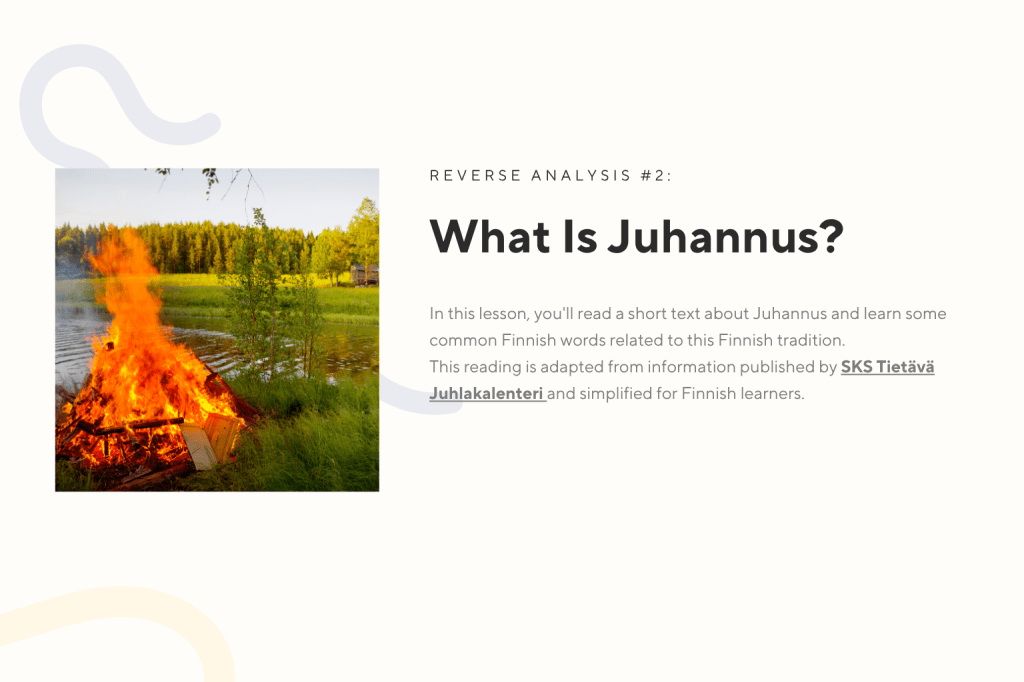
Juhannus is one of the most important celebrations in Finland. It marks the middle of summer and is closely connected to nature, light, and spending time with family and friends.
In this lesson, you’ll read a short text about Juhannus and learn some common Finnish words related to this Finnish tradition.
This reading is adapted from information published by SKS Tietävä Juhlakalenteri and simplified for Finnish learners.
Reading
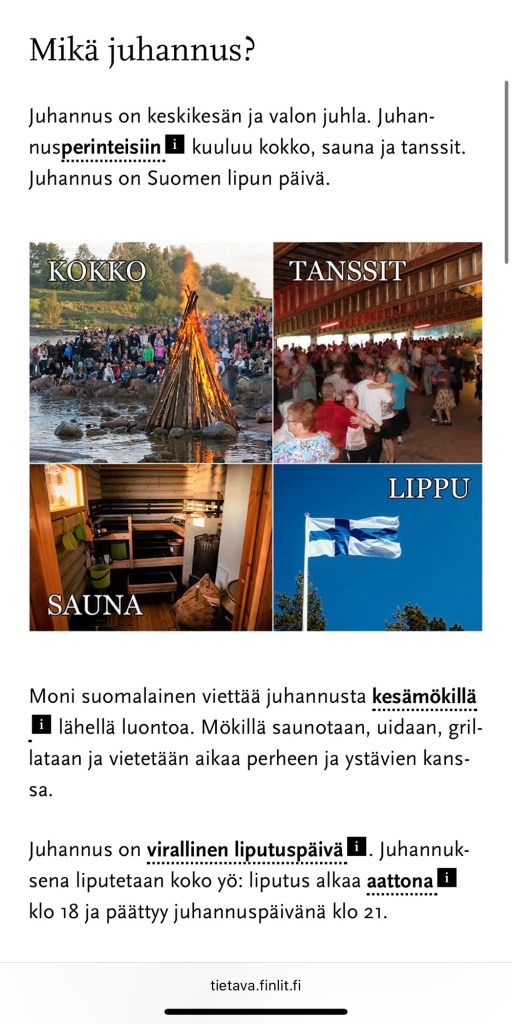
Mikä juhannus on?
Juhannus on keskikesän ja valon juhla.
Juhannusperinteisiin kuuluu kokko, sauna ja tanssit.
Juhannus on Suomen lipun päivä.
Moni suomalainen viettää juhannusta kesämökillä lähellä luontoa.
Mökillä saunotaan, uidaan, grillataan ja vietetään aikaa perheen ja ystävien kanssa.
Juhannus on virallinen liputuspäivä.
Juhannuksena liputetaan koko yö: liputus alkaa aattona klo 18 ja päättyy juhannus päivänä klo 21.
Reverse Analysis
Don’t try to memorise this text.
Instead, look for patterns.
- Which words can you already recognise?
- Can you find any familiar verb forms?
- Do you notice any cases you’ve learned before?
- Which words belong to the same topic?
The goal isn’t to understand every single word immediately. The goal is to train your brain to notice Finnish patterns in real content.
| Juhannus on keskikesän ja valon juhla. Juhannus is a celebration of midsummer and light. | on = present tense of olla (to be). keskikesä-n and valo-n are in the genitive because they describe what kind of celebration of something. (what kind of celebration is) celebration of midsummer and light |
| Juhannusperinteisiin kuuluu kokko, sauna ja tanssit. Midsummer traditions include bonfires, saunas and dances. | kuulua + mihin = to belong to / be part of something. juhannusperinteisiin is in the illative plural because it follows kuulua Finnish often places the thing being discussed at the beginning of the sentence: Juhannusperinteisiin kuuluu… instead of Kokko, sauna ja tanssit kuuluvat juhannusperinteisiin. This word order helps focus attention on the topic (juhannusperinteisiin) rather than the items themselves. |
| Juhannus on Suomen lipun päivä. Juhannus is Finland’s flag day. | Suomen = genitive of Suomi. lipun = genitive of lippu. Suomen lipun päivä = Finland’s flag day. |
| Moni suomalainen viettää juhannusta kesämökillä lähellä luontoa. Many Finns spend Juhannus at a summer cottage close to nature. | viettää + partitiivi Used when talking about celebrating holidays or spending time. viettää juhannusta, viettää joulua, viettää syntymäpäivää, viettää lomaa kesämökillä = adessive (-lla), ( it answer for the question ”Missä = Where”) meaning ”at a summer cottage”. luontoa is partitive because it follows lähellä. lähellä + Partitiivi → lähellä luontoa Genetiivi + lähellä → luonnon lähellä |
| Mökillä saunotaan, uidaan, grillataan ja vietetään aikaa perheen ja ystävien kanssa. At the cottage, people use the sauna, swim, grill and spend time with family and friends. | All verbs are in the passive present: saunotaan, uidaan, grillataan, vietetään. Finnish uses the passive a lot when talking about what people generally do. Suomessa juodaan kahvia. Mökillä saunotaan. Genetiivi + kanssa kanssa is a postposition meaning ”with”. Unlike English prepositions, postpositions come after the noun. The noun before kanssa is usually in the genitive case. Examples: ystävän kanssa = with a friend perheen kanssa = with family ystävien kanssa = with friends |
| Juhannus on virallinen liputuspäivä. Juhannus is an official flag day. | virallinen = official. liputuspäivä is a compound word: liputus + päivä. |
| Juhannuksena liputetaan koko yö: liputus alkaa aattona klo 18 ja päättyy juhannus päivänä klo 21. During Juhannus, the flag is flown all night. Flag flying starts at 6 p.m. on Midsummer Eve and ends at 9 p.m. on Midsummer Day. | Juhannukse-na, aatto-na, juhannuspäivä-nä use the essive case (-na/-nä), often expressing a time period or occasion. liputetaan is passive present of liputtaa alkaa = to start. päättyä = to end. |
Key Vocabulary
| Finnish | English |
|---|---|
| juhannus | Midsummer |
| keskikesä | midsummer |
| valo | light |
| juhla | celebration |
| juhannusperinne | Midsummer tradition |
| kokko | bonfire |
| sauna | sauna |
| tanssit | dances |
| Suomen lippu | Finnish flag |
| kesämökki | summer cottage |
| luonto | nature |
| saunoa | to use a sauna |
| uida | to swim |
| grillata | to barbecue |
| viettää aikaa | to spend time |
| perhe | family |
| ystävä | friend |
Culture Note
Juhannus is celebrated in June around the longest day of the year. It is one of the biggest holidays in Finland, and many people leave the cities to spend the weekend at their summer cottages.
Typical Juhannus activities include heating the sauna, swimming in lakes, grilling food, and gathering around a large bonfire called a kokko. Juhannus is also an official flag day, and the Finnish flag remains flying throughout the night.
Juhannus has very old roots. Long before Christianity arrived in Finland, people celebrated midsummer and the power of nature. Today, Juhannus remains an important part of Finnish culture and summer traditions.
Watch and Learn
Want to see what Juhannus looks like in real life?
Watch the videos below and try to answer these questions:
- What activities can you see?
- Can you spot a kokko?
- Do you see Finnish flags?
- Are people celebrating in the city or in nature?
- Which traditions from your country are similar to Juhannus?

 Learn Finnish by My Way
Jätä kommentti