
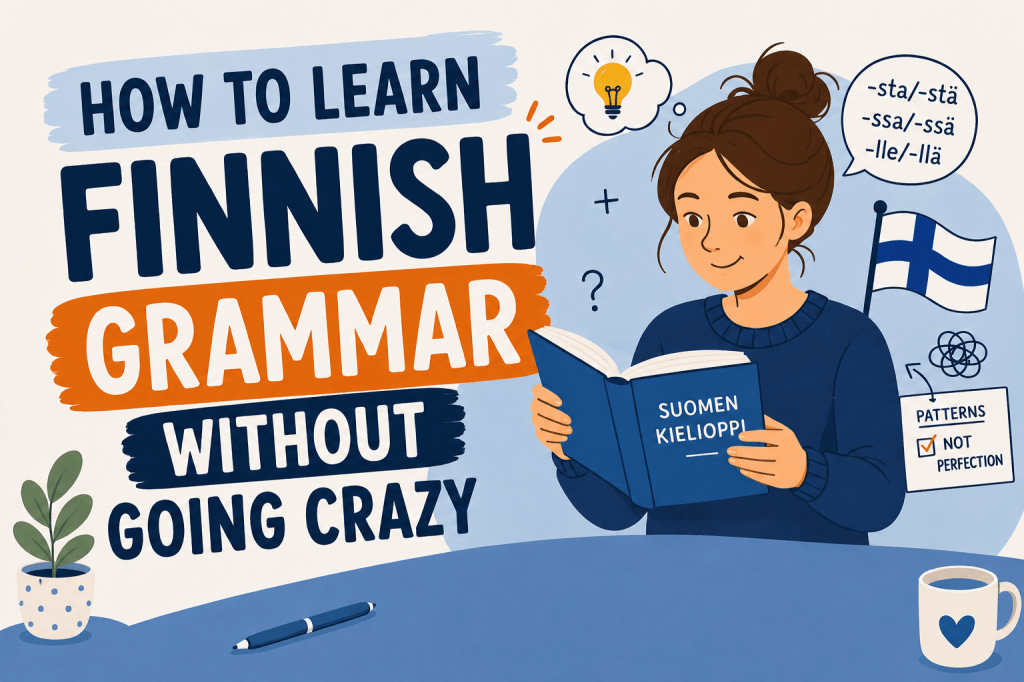
Grammar is probably the least exciting part of learning Finnish. Most learners start with enthusiasm. They learn greetings, introduce themselves, and maybe even manage a short conversation. Then one day they open a grammar book and suddenly find themselves staring at terms like partitive, translative, consonant gradation, or verb rections.
At that point, many people start asking the same question:
Do I really need to learn all of this?
My answer is YES — but probably not in the way you think.
Grammar matters because it gives structure to the language. Without it, you can memorize hundreds or even thousands of words and still struggle to express yourself clearly. The good news is that grammar doesn’t have to be something you suffer through.
Over the years, I’ve changed the way I study Finnish grammar. Instead of trying to memorize every rule, I’ve focused on understanding the patterns that appear repeatedly in real Finnish. This approach has made grammar feel much less overwhelming and much more useful.
Start with the Building Blocks
Before diving into Finnish grammar, it helps to understand the basic building blocks that exist in almost every language. You don’t need to become a linguist, but recognizing these categories makes grammar explanations much easier to follow.
Nouns
Nouns are words that name people, places, things, or ideas. Words such as tyttö (girl), koulu (school), and puhelin (phone) all belong to this category.
Understanding nouns becomes important later because most Finnish case endings are attached to nouns. Once you know which words are nouns, many grammar topics suddenly make much more sense.
Pronouns
Pronouns replace nouns and appear constantly in everyday Finnish. Personal pronouns such as minä, sinä, and hän are among the first words most learners encounter.
As your Finnish improves, you’ll also meet possessive forms (minun, sinun, hänen), demonstrative pronouns (tämä, tuo, se), and relative pronouns (joka, jonka, jota). Learning to recognize them early makes reading considerably easier.
Adjectives
Adjectives describe nouns. When you say kaunis tyttö (beautiful girl), punainen katto (red roof), or iso talo (big house), the adjective provides additional information about the noun.
Verbs
If there is one word class worth paying special attention to, it’s verbs. Verbs describe actions, events, states, and processes.
Examples:
- mennä (to go)
- kävellä (to walk)
- puhua (to speak)
- opiskella (to study)
Finnish grammar is heavily centered around verbs, so this is one category worth paying special attention to.
However, learning the meaning of a verb is only the first step. To use Finnish naturally, you also need to learn verb rections (verbien rektiot). A verb rection tells you what case should follow a particular verb.
For example:
- pitää + elative (-sta/-stä)
- Pidän kahvista.
- (I like coffee.)
- odottaa + partitive
- Odotan bussia.
- (I am waiting for the bus.)
- auttaa + partitive + V-maan
- Autan ystävääni tekemään kotitöitä.
- (I help my friend.)
Many Finnish learners understand the words but still make mistakes because they use the wrong case after the verb. n fact, mastering verb rections is one of the keys to speaking and understanding Finnish accurately. A small case change can completely change the meaning of a sentence or make it sound unnatural to native speakers.
If you want to become more comfortable with Finnish grammar, start paying attention not only to what a verb means, but also to what case comes after it.
Verb rections are one of the most important topics in Finnish grammar, and the best way to learn them is through repeated exposure.
I’ve collected Finnish verb flashcards (mostly from the Suomen Mestari series) that you can use for extra practice. They won’t teach every rection automatically, but they’ll help you build a solid verb foundation before moving on to more advanced grammar.
Adverbs, Conjunctions, and Other Small Words
Words such as hyvin, sujuvasti, ja, mutta, tai, and koska may seem small, but they appear everywhere. These are often the words that make sentences flow naturally.
You’ll also encounter interjections like Vau!, Voi voi!, and Aijai! in conversations, social media posts, and everyday speech.
Learn the Core Grammar First
One of the biggest mistakes learners make is trying to learn everything at once. Finnish grammar is enormous, and you don’t need to master every grammar topic before you start speaking.
Instead, focus on the grammar that appears constantly in everyday Finnish. Learn how verbs are conjugated, how the most common cases work, how consonant gradation affects words, and how tenses are formed. Later, you can gradually add topics such as passive forms, comparison forms, postpositions, and verb rections.
Think of grammar as a toolbox. You don’t need every tool on day one. You only need the tools you’ll actually use.
Learn Sentence Patterns, Not Just Rules
Many learners spend hours reading grammar explanations but never learn actual sentence patterns. As a result, they understand the rules yet still struggle to speak.
Instead of memorizing grammar in isolation, pay attention to complete sentence structures.
For example, Finnish often follows the same basic subject–verb–object pattern as English:
Minä luen kirjaa.
Once you start noticing recurring patterns, grammar becomes easier because you’re seeing it in action rather than studying it as a list of rules.
Some sentence structures appear constantly in everyday Finnish. You’ll repeatedly see patterns for possession (Minulla on auto), obligation (Minun pitää opiskella), existence (Suomessa on paljon metsiä), and commands (Lue kirja!).
The goal is not just to know the rule. The goal is to recognize the pattern whenever you encounter it.
Don’t Learn Grammar Only from Grammar Books
This is probably the most important advice in this article.
Grammar books are excellent for explaining grammar, but they don’t create language intuition. You can understand every rule on the page and still struggle to use Finnish naturally in real life.
Real learning happens when grammar meets real language. Read articles. Listen to podcasts. Watch videos. Pay attention to the patterns you keep seeing.
After you’ve encountered structures like Minulla on aikaa, Minulla on kiire, and Minulla on ongelma hundreds of times, they eventually stop feeling like grammar. They simply feel natural.
At some point, you stop translating. You start recognizing.
Eventually, you start producing those structures yourself.
My Favorite Method: Reverse Analysis
Over the years, my goal has changed. I no longer study Finnish just to pass exams. I study Finnish because I live in Finland and want to use the language naturally in everyday life.
One method I use constantly is something I call reverse analysis.
When I come across a sentence I don’t fully understand, I don’t immediately move on. Instead, I investigate it. I look up unfamiliar grammar points, compare examples, and break the sentence apart until everything makes sense.
Most textbooks teach grammar first and examples second. Reverse analysis does the opposite. I start with real Finnish and work backwards to understand the grammar behind it.
Sometimes I spend twenty minutes analyzing a single sentence. It sounds slow, but the learning is much deeper because the grammar is connected to something meaningful rather than an abstract rule on a page.
Grammar Is Not the Goal
This might sound strange coming from someone who enjoys analyzing grammar, but grammar is not the goal.
Communication is the goal.
Grammar is simply one of the tools that helps you communicate more accurately and more naturally.
Learn the rules. Learn the patterns. Read real Finnish. Listen to real Finnish. Collect useful expressions. Analyze the language that interests you.
Most importantly, be patient with yourself.
Finnish grammar is not something you master in a few months. It is something you gradually absorb through years of exposure and use. Every article you read, every podcast you listen to, and every conversation you have helps build that understanding little by little.
One day you’ll notice that structures which once seemed impossible now feel completely natural. And that’s when you realize the process has been working all along.



 Learn Finnish by My Way
Jätä kommentti